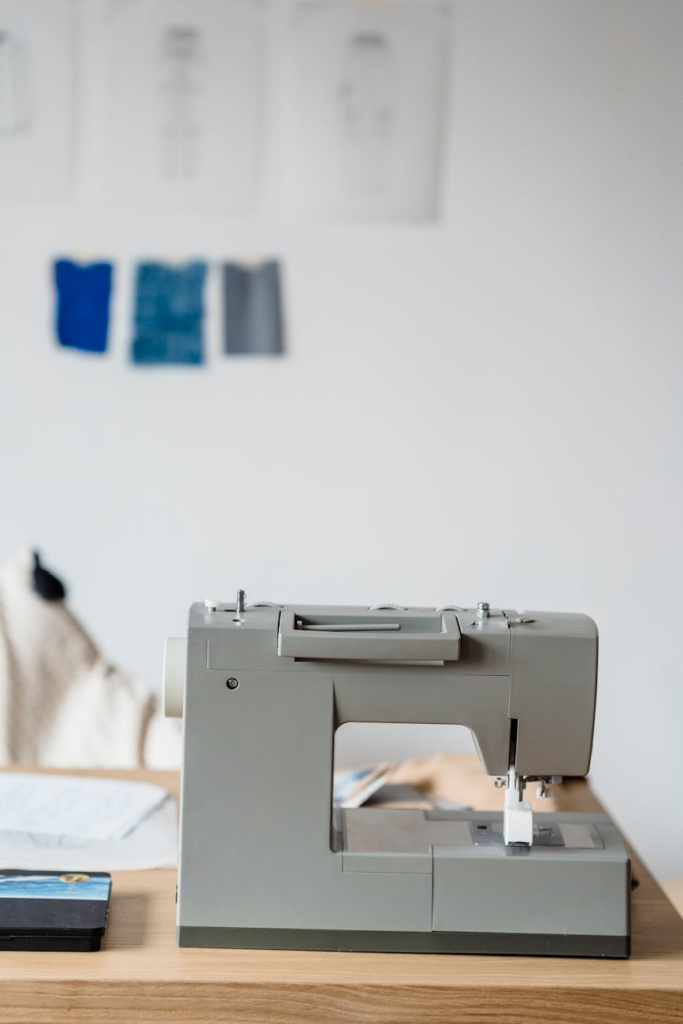
Sewing machine 101
How to Thread the Sewing Machine
(Step-by-Step Guide for Beginners)
(Or: You’re allowed to begin again)
Learning how to thread a sewing machine isn’t something you “should already know.” It’s something you’re allowed to learn slowly—with pauses, resets, and as many tries as you need. This is a soft guide for threading the top of your machine—not for perfection, but for presence.
Before we start, take a breath.
Really—pause. Let the air come in. Let your shoulders drop.
Because if you’ve been avoiding this part, you’re not the only one.
Threading the sewing machine is one of those steps people assume you already know. Like it came pre-installed. Like you missed the one lesson everyone else somehow got.
You didn’t.
And nothing about this moment determines how creative you are.
So. Let’s begin again.
Not at confidence. Not at speed. But here—with the quiet willingness to stay.
Note: Don’t have your bobbin wound yet?
No rush. Pause here and follow this guide on [how to wind and load a bobbin]—then come back when you’re ready.
This is a slow sewing guide meant for beginners—no rushing, no performance, just presence.
Step-by-Step Instructions
Step One: Sit with the machine before you touch it.
No parts yet. No steps.
Just look at it.
Imagine it as a quiet friend—not an obstacle.
Picture this:
     ____________________
    |                    |
    |   [spool]     [wheel]|
    |                    |
    |   Needle →         |
    |____________________|
Nothing else matters right now but noticing.
You’re allowed to arrive exactly as you are.
Step Two: Notice the thread path before you follow it.
Find where the thread spool sits. Let your eyes follow the possible journey. Let them linger.
Here’s a simple visual to hold in your mind:
  (Spool)
     o
     |
     ▼
  [Guide]—→(Tension Disk)
     |
     ▼
   (Take‑up Lever)
     |
     ▼
  (Needle)
Don’t touch anything yet.
This is where understanding matters more than speed.
You’re allowed to learn slowly.
Step Three: Begin to thread.
Start at the top. Guide the thread from the spool to the first hook.
Picture it like tracing a path on a map.
   o   ← Spool
   |
   ▼
  —→◦ Guide
      |
     ▼
   —→◦ Next
If you miss a place, no problem. Just loop back gently and try again.
Nothing has gone wrong.
Step Four: The tension point (let’s slow way down here)
This is where fear likes to show up.
So let’s imagine it in simple shapes:
  O———T
   ↑
 Thread
“T” is the tension disc — a place where thread slows, just like your breath might right now.
Here’s what you do:
Pause. Let your eyes rest here before moving on.
If you need to re-thread — again — that’s okay. Really.
This step is reversible. Nothing is broken. Nothing is fragile.
Step Five: Thread the needle (your patience matters)
Needle threading is small-space breathing.
Here’s an idea to hold in your mind:
       |
      Needle
       ●  ← Thread tip here
If your eyes blur, if your hands wobble—let that be part of the quiet rhythm.
Take breaths between attempts.
You’re not being watched.
You’re not being graded.
You can stay.
Step Six: Pause before the first test stitch
Before you sew a stitch, pause again.
Look at the thread.
Ask yourself:
What do I notice?
Not “Is it correct?” but “What do I see?”
Now imagine this:
|—–•—–| ← Test stitch line
This line isn’t a verdict.
It’s information.
Curiosity matters more than perfection.
What to Do When It Goes Wrong?
A loop here. A skipped guide there.
Don’t rush past this part.
When something goes wrong, slow down after it.
Imagine this:
   tangled loop
      ∞
   gently unwind
      ↶ ↷
Undo gently. No shame. No hurry.
This is where safety is proven, not just promised.
Now — quietly — you did it.
Not perfectly. Not without pause.
But you stayed.
You tried.
You didn’t talk yourself out of it.
That matters more than any pattern’s first stitch.
If you can thread a machine—with care, with interruptions, with softness—then you can begin again. You can let things be crooked and still wonderful.
Right here is enough.
💌 Want gentle, beginner-friendly help across your whole sewing setup?
Grab the free Beginner Sewing Roadmap here →
You stayed. That’s the real progress.
You just completed your first sewing machine threading tutorial – not perfectly, but with care. That’s more than enough.
Not because the thread’s perfect.
Not because the stitches worked on the first try.
But because you let yourself begin.
That’s what builds creative trust—not mastery, but presence.
Where to next? (No rush.)
When you’re ready, you can keep going gently here:
→ [First Stitches Without Fear: Making Peace with the First Line of Sewing]
A quiet invitation to feed the fabric and find your rhythm.
Or, if something tangled, or you need to start again:
→ [How to Wind and Load a Bobbin]
Nothing is broken. Here’s how to begin again, softly.
Even if your thread broke, even if it took three tries, you showed up today. And that matters. Take a breath. Touch your fabric. You’re a sewist now—even if you’re still figuring it out.
Sew What by Winter is a quiet place for beginners and re-beginners. You’re always welcome here, exactly as you are.
→ Next step: Try a simple project (like a pillowcase or napkin), or read Sewing Without Fear if you still feel nervous.